Brazilian Scholar: Hydrogen Molecule Inhalation Improves Cognitive Impairment in Sepsis!
Sepsis refers to an acute systemic infection caused by various pathogens invading the bloodstream,multiplying,and producing toxins.The factors leading to sepsis are as follows:【1】
Sepsis is a severe disease.According to statistics,there are approximately 5 million new sepsis patients annually in China,with fatalities reaching up to 1 million.It is the leading cause of death among non-cardiac patients in intensive care units.
The systemic inflammation caused by sepsis can lead to acute brain dysfunction,manifesting as delirium,coma,and cognitive impairment.Nearly half of sepsis patients experience brain sequelae.With the continuous advancement of medical technology,the survival rate of sepsis has improved,but how to ameliorate cognitive impairment in sepsis survivors has become a key focus in the medical field.
Given that systemic inflammation is a key feature of sepsis,and molecular hydrogen possesses anti-inflammatory and antioxidant mechanisms,the research team from the University of São Paulo,Brazil's top institution,conducted two attempts to use hydrogen inhalation to improve cognitive impairment in sepsis.
2020 ExperimentIn 2020,the University of São Paulo team used a cecal ligation and puncture(CLP)model to analyze the effects of molecular hydrogen on the survival rate,short-term and long-term cognitive abilities of septic rats,observing the improvement of memory and cognitive function in septic rats through long-term hydrogen-oxygen inhalation.[2]
The results showed that the survival rate of the sepsis model inhaling hydrogen-oxygen gas was as high as 81%,while that of the group inhaling air was only 53%.
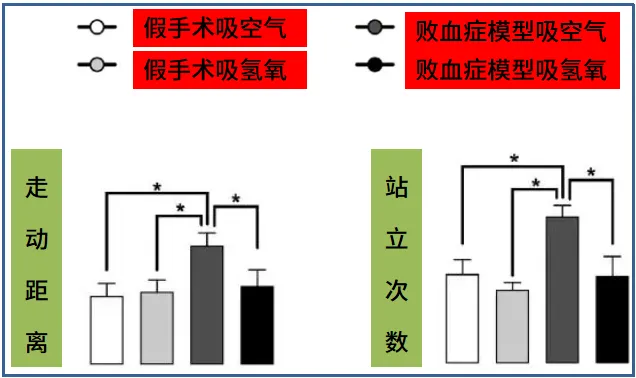
To study cognitive impairment in the rat model,Brazilian scientists designed a simple protocol:first,rats were placed in an unfamiliar environment for 5 minutes of exploration,then removed.When the rats were reintroduced to the same environment one day later,the number of times they stood up to observe and the distance they walked for exploration were measured.If the rats returning to the original environment exhibited more standing observations and longer walking distances,it indicated more severe memory loss.The results showed that rats inhaling hydrogen-oxygen gas walked shorter distances and stood up to observe less frequently when returning to the familiar environment,indicating that hydrogen-oxygen inhalation improved memory in the sepsis model rats.The results are as follows:
Since hydrogen molecules have been shown to improve short-term and long-term recognition memory impairments not caused by white matter damage,the researchers proposed investigating whether the same protective effect could be observed in cognitive impairment induced by sepsis in rats.In the conditioned reflex training,the researchers found that when tested 1 day and 5 days later,the freezing behavior in the sepsis-air group was significantly higher than that in the sham-surgery air group and the sham-surgery hydrogen-oxygen group,confirming the establishment of the cognitive impairment model.After inhaling hydrogen-oxygen,a significant reduction in freezing responses was observed in two long-term memory tests,indicating that hydrogen molecules improved the impaired cognitive memory in septic animals.
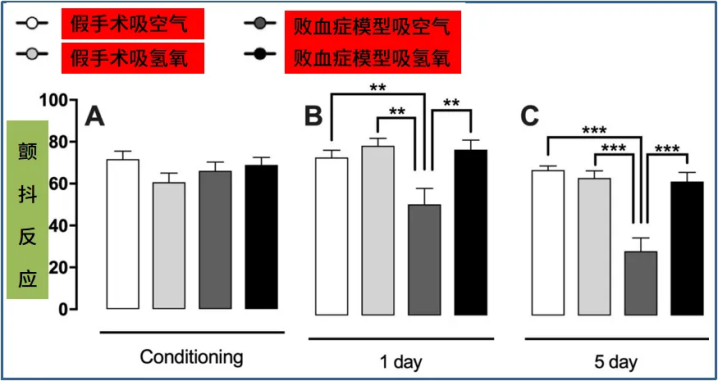
Brief description of the experiment:Scientists trained rats with 10 foot shocks and observed the responses of different groups after 1 day and 5 days using the same procedure.If the freezing response was strong and lasted longer,it indicated that the rats retained more fear of the shock,reflecting better cognitive status.As shown in the figure above:Among septic rats,those inhaling hydrogen-oxygen retained fear cognition almost as well as the normal group,while septic rats inhaling air showed significant forgetting of fear.
Additionally,scientists measured the levels of pro-inflammatory cytokines(IL-1βand IL-6)and the anti-inflammatory cytokine(IL-10)in the prefrontal cortex and hippocampus of septic rats to verify the anti-inflammatory effects of hydrogen molecules in sepsis.Compared with the sham group,the air group showed significantly elevated levels of IL-1βand IL-6 in the prefrontal cortex;compared with the air-treated group,inhaling hydrogen-oxygen reduced the production of these pro-inflammatory cytokines in the prefrontal cortex of rats.
Scientists examined the expression of the transcription factor Nrf2.Using Western blotting,it was observed that compared to the sham-operated group and the sepsis air group,the total Nrf2 expression in the hippocampus and prefrontal cortex of sepsis rats treated with hydrogen molecules was elevated.This indicates that emergency inhalation of hydrogen-oxygen affects Nrf2 expression in septic animals.
2023 PaperIn 2023,the aforementioned team from the University of São Paulo in Brazil published another significant paper,corroborating the mechanism by which hydrogen molecule inhalation improves hippocampal neuroinflammation,glial reactivity,and systemic inflammation.This article was published in the internationally renowned journal Elsevier.[3]
Screenshot of the paper
Scientists used lipopolysaccharide(LPS)to induce systemic inflammation(SI)to simulate sepsis,while also triggering neuroinflammation in different regions related to memory and learning.In this experiment,to study the effects of hydrogen-oxygen and air on sepsis(LPS),scientists established four groups:
Sal+Air:Injected with saline+inhaled air
LPS+Air:Injected with LPS+inhaled air(Sepsis group)
Sal+H2:Saline injection+Hydrogen-oxygen inhalation
LPS+H2:LPS injection+Hydrogen-oxygen inhalation(Sepsis group)
Scientists first tested the levels of four types of pro-inflammatory cytokines in the plasma of each group.The results showed that the pro-inflammatory cytokines remained stable in the sham surgery group injected with saline.In the sepsis group injected with LPS,the levels of pro-inflammatory cytokines increased—as shown by the red bars(inhaling air)in the figure below,all types of pro-inflammatory cytokines surged,while the levels in the hydrogen-oxygen inhalation group were significantly lower.This comparison indicates that hydrogen-oxygen inhalation inhibits plasma pro-inflammatory cytokines.
To observe the neuroinflammation in the LPS-induced sepsis model,scientists performed section staining on the dorsal hippocampal CA1 region.The results revealed that hydrogen-oxygen inhalation significantly reduced the intensity induced by LPS,with lower reactivity in microglia and astrocytes.
The above image shows two rows of microphotographs of microglial cells(IBA-1+),with the right side being a local magnification.It can be observed that:Inhaling hydrogen-oxygen suppressed the intensity and area changes of microglial cells(IBA-1+),maintaining a level similar to the normal(sham surgery group),while the sepsis air group(red bar)showed very significant changes.
Similarly,micrographs of astrocytic GFAP also demonstrate that inhaling hydrogen-oxygen reduces the intensity and area of astrocytes in the LPS-induced sepsis model.
Microglial cells are smaller,oval-shaped cells compared to astrocytes.They primarily secrete neurotransmitters in the brain,regulate and control neural activities,and are involved in processes such as memory,thinking,and learning.
Astrocytes are larger cells with a star-like shape.Their main functions include controlling and regulating neural activities in the brain,as well as participating in processes such as memory,cognition,and logical thinking.
Similarly,scientists tested the levels of pro-inflammatory factors in plasma.The results showed that hydrogen-oxygen inhalation inhibits pro-inflammatory factors in sepsis,as follows:
As in the 2020 experiment,scientists in this study also compared long-term memory,short-term memory,and stress responses across groups.The results also indicated that hydrogen-oxygen inhalation improves cognitive impairment caused by sepsis.As follows:
SummaryThrough biological effects such as anti-inflammatory and antioxidant actions,hydrogen-oxygen reduces the activation of microglia and astrocytes related to cognition,suppresses the surge of pro-inflammatory factors,thereby inhibiting the neuroinflammatory response induced by sepsis and alleviating the cognitive damage and memory loss caused by sepsis.In over a decade of clinical trials on hydrogen-oxygen inhalation,no reports of any toxic side effects have been found.Brazilian scientists also noted in the original text:"This is a relatively easy-to-use,inexpensive,and effective method."
With the advancement of medical standards and the extension of life expectancy among the elderly,many major diseases(such as cancer,cerebral infarction,etc.)in elderly patients can lead to sepsis and postoperative delirium due to surgical infections.In addition to the sepsis-induced cognitive impairment animal model studied by the Brazilian team,the team led by Professor Xie Keliang from Tianjin Medical University in China has applied high-concentration hydrogen-oxygen inhalation in clinical trials to improve postoperative delirium in humans.They found that pre-inhalation of hydrogen-oxygen can exert anti-inflammatory and antioxidant mechanisms,which may help prevent and improve postoperative delirium in elderly patients.
Compared to the high treatment costs of sepsis and the economic burden caused by long-term sequelae,hydrogen-oxygen inhalation may be a potential method for humans to prevent sepsis-induced cognitive impairment and improve neurodegenerative diseases!
Previously,this official account has also reported clinical cases of hydrogen-oxygen inhalation improving Alzheimer's disease.
References:[1]Lu Zhongqiu et al.Clinical and Epidemiological Characteristics of Vibrio vulnificus Sepsis.Chinese Journal of Critical Care Medicine,2003;[2]Jesus AA,Passaglia P,Santos BM,et al.Chronic molecular hydrogen inhalation mitigates short and long-term memory loss in polymicrobial sepsis.Brain Res.2020;1739:146857.doi:10.1016/j.brainres.2020.146857[3]Jesus AA,Passaglia P,Santos BM,et al.Inhaled molecular hydrogen reduces hippocampal neuroinflammation,glial reactivity and ameliorates memory impairment during systemic inflammation,ELSEVIER,Brain,Behavior,&Immunity-Health 31(2023)100654 


