Late nights,long shifts,
Strong drinks and the spiciest foods—
...
This carefree lifestyle
is pushing
your liver to its limits.
Eventually,
the liver can’t keep up.
March 18
marks the 25th National Liver Care Day.
This year’s theme is
“Combining Traditional Chinese and Western Medicine to Reverse Liver Cirrhosis.”
Join us and learn more about
caring for your body’s“little liver.”
01
Understanding"Little Liver"
The liver is one of the body’s five major organs and serves as its metabolic hub.Often called the body’s“chemical plant,”it handles vital functions such as metabolism,detoxification,and protein synthesis,working around the clock to maintain overall health.
Interestingly,the liver is the only organ without pain-sensing nerves.This means that even when it is diseased,it doesn’t“cry out.”By the time symptoms appear,significant damage has often already occurred.
Did you know?China is considered a major country for liver diseases.Estimates indicate there are roughly 86 million hepatitis B carriers,including 28 million who require treatment.Additionally,about 10 million people have hepatitis C,and nearly 300 million suffer from fatty liver disease.
As Traditional Chinese Medicine says,“All diseases originate from the liver;nurturing the liver is nurturing life.”This highlights just how important liver health is and why it should never be overlooked.
Hydrogen molecules have antioxidant and anti-inflammatory properties,offering potential therapeutic benefits for inflammation-related conditions,including liver disease.Researchers are actively exploring this potential.
02
Research on Hydrogen-Oxygen Medicine
For example,a team led by Professor Qin Shucun at the Taishan Hydrogen Biomedical Research Institute,Shandong First Medical University,conducted a study involving 62 patients with non-alcoholic steatohepatitis(NASH).The results were published in the academic journal WILEY in June 2022.
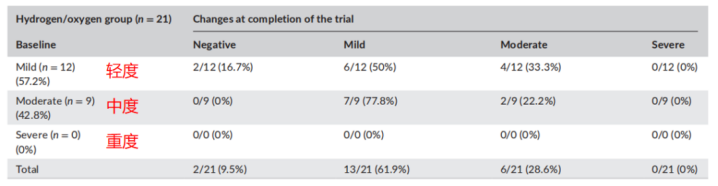
Patients were randomly divided into two groups:Placebo group:32 patients;Hydrogen-oxygen group:30 patients,inhaling a high-concentration hydrogen-oxygen mixture(66.6%hydrogen,33.3%oxygen)Both groups underwent hydrogen-oxygen inhalation therapy for 13 weeks.
The pre/post-trial data for the mild,moderate,and severe categories in the hydrogen-oxygen inhalation group are as follows:
The pre/post-trial data for the mild,moderate,and severe categories in the placebo group are as follows:
In the hydrogen-oxygen group,the proportion of patients improving to mild fatty liver was higher than in the placebo group,and no cases of severe fatty liver were observed after treatment.
Researchers also measured the liver-to-spleen density ratio(CTL/S),where a smaller ratio indicates more severe fatty liver.
After the trial,the hydrogen-oxygen group showed significant improvement,demonstrating that hydrogen-oxygen inhalation can effectively improve fatty liver.
Professor Qin’s research suggests that hydrogen-oxygen inhalation has broad potential applications for liver health,and we look forward to further studies in this area.
Liver Health Tips
Start the day with a cup of warm water to help flush toxins.
Eat balanced meals:moderate salt and sugar,avoid overly rich foods,and aim for three meals at about 70%fullness.
Sleep before midnight to allow your liver to rejuvenate naturally.
Limit alcohol,as it can damage the liver.Enjoy in moderation if at all.
Follow your doctor’s instructions for medications,and avoid unverified remedies that may harm your liver or digestive system.
Avoid moldy or spoiled foods;fresh vegetables and fruits support liver health.
If lab tests show abnormal liver indicators,seek early evaluation and treatment without panic.
Hepatitis B vaccination helps protect the liver from viral infection.
If your skin or eyes appear yellow,consult a doctor promptly.
Note:These tips,generated by DeepSeek AI,are for reference only.
References:[1]Geru Tao,Guangjie Zhang,Wei Chen,Chao Yang,Yazhuo Xue,Guohua Song,Shucun Qin.A randomized,placebo-controlled clinical trial of hydrogen/oxygen inhalation for non-alcoholic fatty liver disease.WILEY.4 June 2022 DOI:10.1111/jcmm.17456 


