Cardiovascular diseases are a leading cause of human mortality.During the progression of cardiovascular diseases,excessive oxidative stress and inflammatory responses play significant roles.Hydrogen-oxygen inhalation is colorless,odorless,non-toxic,and harmless.According to the standards for Class III medical devices,patients can safely inhale the hydrogen-oxygen mixture to achieve the health improvement effects clinically required by physicians.
Furthermore,due to the small molecular size of hydrogen,which allows it to easily penetrate cell membranes,and the fact that the hydrogen-oxygen gas mixture can be metabolized without leaving residues,hydrogen-oxygen inhalation has also demonstrated improvement effects on diseases of the nine major human systems.Consequently,a large number of medical researchers worldwide are utilizing hydrogen-oxygen inhalation to combat various diseases.Recently,scientists from the Faculty of Medicine at Chiang Mai University in Thailand compiled and analyzed research findings on the therapeutic intervention of hydrogen-oxygen in heart diseases.[1]
This paper was published in CELLULAR AND MOLECULAR LIFE SCIENCES.
Hydrogen-Oxygen vs.Ischemia-Reperfusion InjuryIschemia-reperfusion injury(I/R)that occurs in situations such as myocardial infarction,heart transplantation,or cardiopulmonary bypass can trigger excessive oxidative stress,which may lead to direct cellular damage and apoptosis,ultimately resulting in heart damage or even death.[2]Various studies have demonstrated that inhaling hydrogen-oxygen gas to uptake hydrogen molecules can exert selective antioxidant effects,thereby mitigating the damage caused by ischemia-reperfusion injury to the heart.Experiments have shown that hydrogen molecule uptake can improve heart disease,reduce infarct size,and alleviate cardiac damage.Other experiments have also proven that hydrogen molecule uptake decreases myocardial infarction area,reduces the incidence of ventricular fibrillation(VF)/ventricular tachycardia(VT),and improves cardiac function[3].
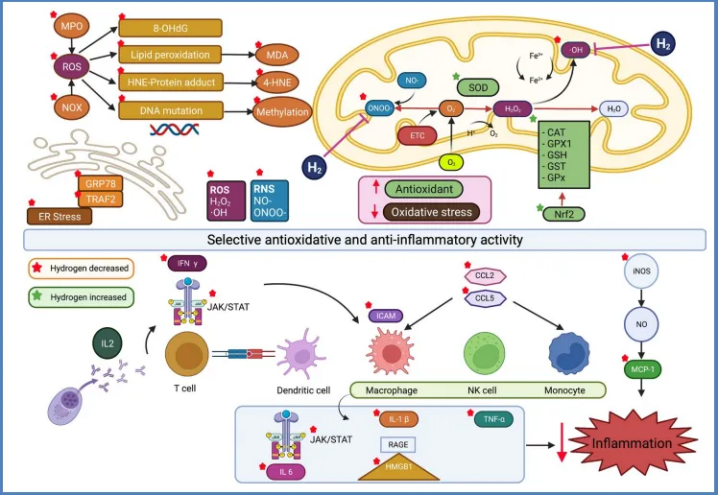
Oxidative stress is a necessary physiological response,but excessive oxidative stress can harm the body and promote the development of many chronic diseases.The unique property of hydrogen lies in its ability to penetrate cell membranes and selectively eliminate harmful excessive oxidative stress in the human body.The figure above is a schematic diagram compiled by international scholars illustrating hydrogen's selective antioxidant and anti-inflammatory effects.In the diagram,the green star represents an increase in hydrogen levels,accompanied by improvements in various indicators in the body;the red star represents a decrease in hydrogen levels,accompanied by various excessive oxidative stress events,leading to bodily damage.Cardiac status is closely linked to mitochondrial status.The following experiments also highlight the improving effects of hydrogen molecules on mitochondria.
Hydrogen-Oxygen vs.Myocardial Infarction(MI)and Chronic Intermittent Hypoxia(CIH)Myocardial infarction(MI)is one of the leading causes of human death,which can induce myocardial necrosis and interstitial fibrosis,leading to heart failure and increasing mortality[4].In animal experiments,scientists have found that hydrogen-oxygen inhalation can improve cardiac function and alleviate myocardial pathological changes.[5]In chronic intermittent hypoxia(CIH)rats,hydrogen-oxygen inhalation reduces oxidative stress and improves cardiac dysfunction.Additionally,hydrogen molecules attenuate endoplasmic reticulum stress-induced apoptosis through pathways such as PERK-eIF2α-ATF4,IRE1-XBP1,and ATF6.
The above diagram illustrates the potential mechanisms by which hydrogen molecules reduce cell death.Scientists have pointed out that hydrogen molecules can effectively reduce apoptosis,endoplasmic reticulum stress,and pyroptosis.Hydrogen molecules have been shown to enhance autophagy,mitophagy,and survival kinases,thereby inhibiting cell death.
Hydrogen-Oxygen vs.AtherosclerosisAtherosclerosis is a process closely associated with cardiovascular diseases,representing a state of oxidative stress and inflammation characterized by the accumulation of macrophages and oxidized lipoprotein products in the affected blood vessels.Hydrogen-oxygen inhalation for 6 months effectively reduces oxidative stress and has the potential to decrease atherosclerotic lesions in the aorta.[6]
Previous studies have shown that hydrogen-oxygen inhalation can increase blood flow,thereby inhibiting atherosclerosis.
Hydrogen-Oxygen vs.Impact of Sepsis on the HeartSepsis is a systemic inflammatory response to infection involving the cardiovascular system,with cardiomyocytes participating due to impaired cellular oxygen consumption.Correspondingly,mitochondrial dysfunction leads to cellular energy expenditure.Recent studies have shown that hydrogen-oxygen treatment can upregulate the protein expression of mitochondrial fusion protein-2,peroxisome proliferator-activated receptor gamma coactivator-1α,and heme oxygenase-1 to reduce mitochondrial dysfunction.
In a study by a Brazilian medical team,hydrogen-oxygen inhalation significantly improved the survival rate in animal models of sepsis.
Hydrogen-Oxygen vs.Myocardial HypertrophyMyocardial hypertrophy is composed of interstitial and perivascular fibrosis,which can lead to heart failure and consequently increased mortality.Hypertension is a major factor associated with left ventricular hypertrophy.Animal models of myocardial hypertrophy have demonstrated that hydrogen molecule intake can reduce heart and atrial weight.Hydrogen reduces the incidence of atrial fibrillation(AF),atrial fibrosis,apoptosis,and inflammation by downregulating the JAK-STAT signaling pathway,thereby protecting ventricular mitochondria.[7]
Hydrogen-Oxygen vs.Heart TransplantationHeart transplantation is a primary cause of cardiac ischemia-reperfusion injury(I/R).After the heart is removed,a period of cold ischemia inevitably occurs due to tissue matching,transportation,and other factors.It has been found that organ preservation solutions can only partially alleviate ischemic injury during storage.Studies have shown that preserving the heart in an environment rich in hydrogen molecules can effectively improve cardiac function,providing further evidence from an ex vivo perspective of the benefits of hydrogen-oxygen for the heart.[8]When animal hearts were stored at 4°C for several hours,the recovery time for hearts without hydrogen to resume beating after rewarming to 37°C was approximately 4 minutes,whereas the recovery time for hearts preserved in a solution containing hydrogen was reduced to 1 minute.
Results and DiscussionDue to its mechanisms such as small molecular size,strong permeability,anti-inflammatory effects,antioxidant properties,and mitochondrial protection,sufficient evidence has been accumulated in vivo,in vitro,ex vivo,and clinical settings to demonstrate the potential protective effects of hydrogen-oxygen on the heart.
Based on these studies,the field of hydrogen-oxygen medicine should further explore the mechanisms by which hydrogen-oxygen reduces ventricular dilation,lowers wall stress,and reverses adverse cardiac remodeling.Investigating pathways related to oxidative stress and inflammation may help uncover the reasons behind hydrogen-oxygen's cardioprotective effects.For the elderly population with a high incidence of heart disease,the potential effects of hydrogen-oxygen should not be overlooked by any family!
References:[1]Kwannapas Saengsin et al,Hydrogen therapy as a potential therapeutic intervention in heart disease:from the past evidence to future application,Cellular and Molecular Life Sciences,(2023)80:174[2]Yao L,Chen H,Wu Q,Xie K(2019)Hydrogen-rich saline alleviates inflammation and apoptosis in myocardial I/R injury via PINK-mediated autophagy.Int J Mol Med 44:1048–1062[3]Sakai K,Cho S,Shibata I,Yoshitomi O,Maekawa T,Sumikawa K(2012)Inhalation of hydrogen gas protects against myocardial stunning and infarction in swine.Scand Cardiovasc J 46:183–189[4]Kitakaze M,Asakura M,Kim J,Shintani Y,Asanuma H,Hamasaki T et al(2007)Human atrial natriuretic peptide and nicorandil as adjuncts to reperfusion treatment for acute myocardial infarction(J-WIND):two randomised trials.Lancet 370:1483–1493[5]Jing L,Wang Y,Zhao XM,Zhao B,Han JJ,Qin SC et al(2015)Cardioprotective effect of hydrogen on isoproterenol-induced myocardial infarction in rats.Heart Lung Circ 24:602–610[6]O et al,(2008)Consumption of hydrogen water prevents atherosclerosis in apolipoprotein E knockout mice.Biochem Biophys Res,Commun 377:1195–1198[7]Yu YS,Zheng H(2012)Chronic hydrogen-rich saline treatment reduces oxidative stress and attenuates left ventricular hypertrophy in spontaneous hypertensive rats.Mol Cell Biochem 365:233–242[8]Tan M,Sun X,Guo L,Su C,Xu Z(2013)Hydrogen as additive of HTK solution fortifes myocardial preservation in grafts with prolonged cold ischemia.Int J Cardiol 167:383–390 


